October 5, 2026
Press
Architecture that listens before it speaks
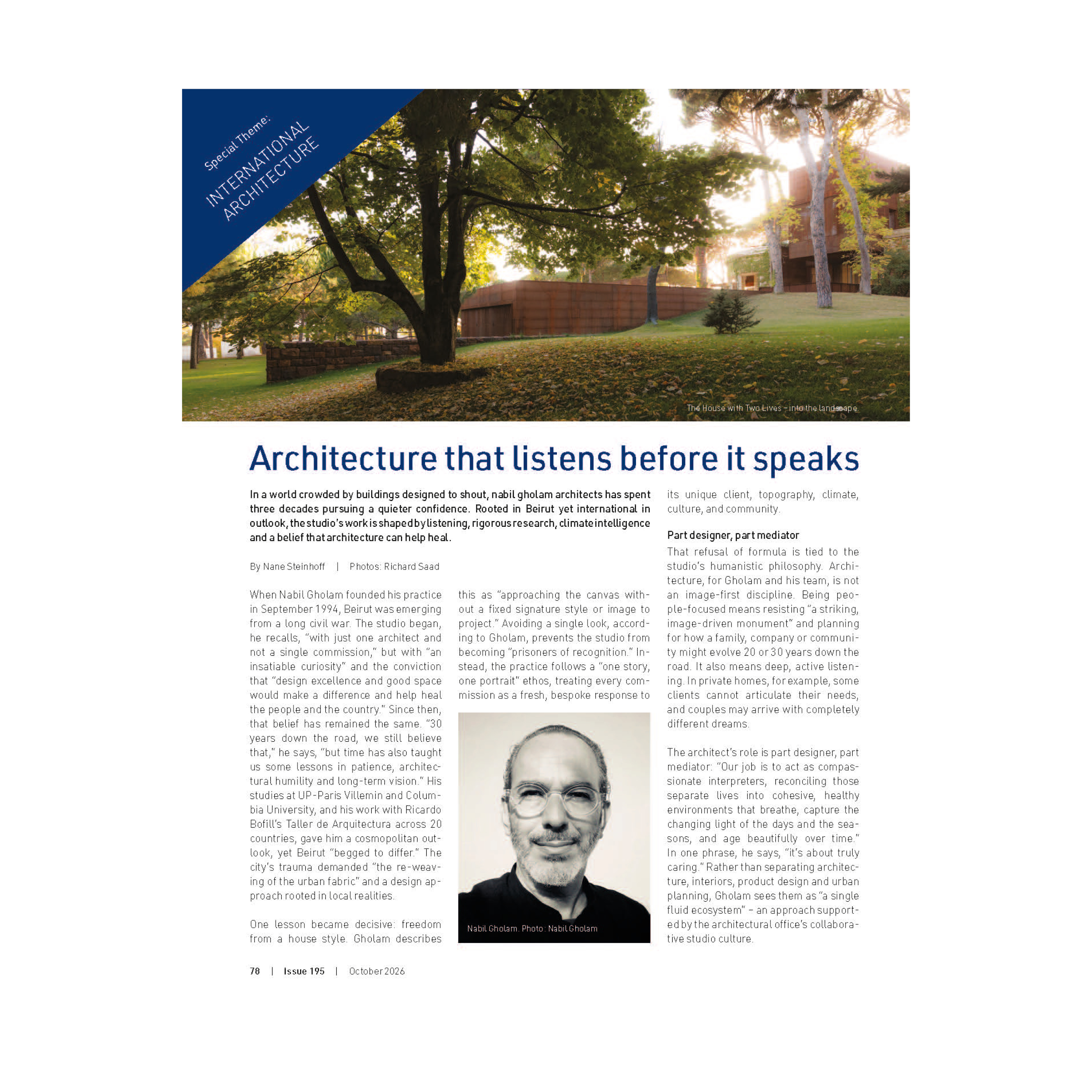
in a world crowded by buildings designed to shout, nabil gholam architects has spent three decades pursuing a quieter confidence. Rooted in Beirut yet international in outlook, the studio’s work is shaped by listening, rigorous research, climate intelligence and a belief that architecture can help heal.
When Nabil Gholam founded his practice in September 1994, Beirut was emerging from a long civil war. The studio began, he recalls, “with just one architect and not a single commission,” but with “an insatiable curiosity” and the conviction that “design excellence and good space would make a difference and help heal the people and the country.” Since then, that belief has remained the same. “30 years down the road, we still believe that,” he says, “but time has also taught us some lessons in patience, architectural humility and long-term vision.” His studies at UP-Paris Villemin and Columbia University, and his work with Ricardo Bofill’s Taller de Arquitectura across 20 countries, gave him a cosmopolitan outlook, yet Beirut “begged to differ.” The city’s trauma demanded “the re-weaving of the urban fabric” and a design approach rooted in local realities.
One lesson became decisive: freedom from a house style. Gholam describes this as “approaching the canvas without a fixed signature style or image to project.” Avoiding a single look, according to Gholam, prevents the studio from becoming “prisoners of recognition.” Instead, the practice follows a “one story, one portrait” ethos, treating every commission as a fresh, bespoke response to its unique client, topography, climate, culture, and community.
Part designer, part mediator
That refusal of formula is tied to the studio’s humanistic philosophy. Architecture, for Gholam and his team, is not an image-first discipline. Being people-focused means resisting “a striking, image-driven monument” and planning for how a family, company or community might evolve 20 or 30 years down the road. It also means deep, active listening. In private homes, for example, some clients cannot articulate their needs, and couples may arrive with completely different dreams.
The architect’s role is part designer, part mediator: “Our job is to act as compassionate interpreters, reconciling those separate lives into cohesive, healthy environments that breathe, capture the changing light of the days and the seasons, and age beautifully over time.” In one phrase, he says, “it’s about truly caring.” Rather than separating architecture, interiors, product design and urban planning, Gholam sees them as “a single fluid ecosystem” – an approach supported by the architectural office’s collaborative studio culture.
Quiet buildings, rigorous research
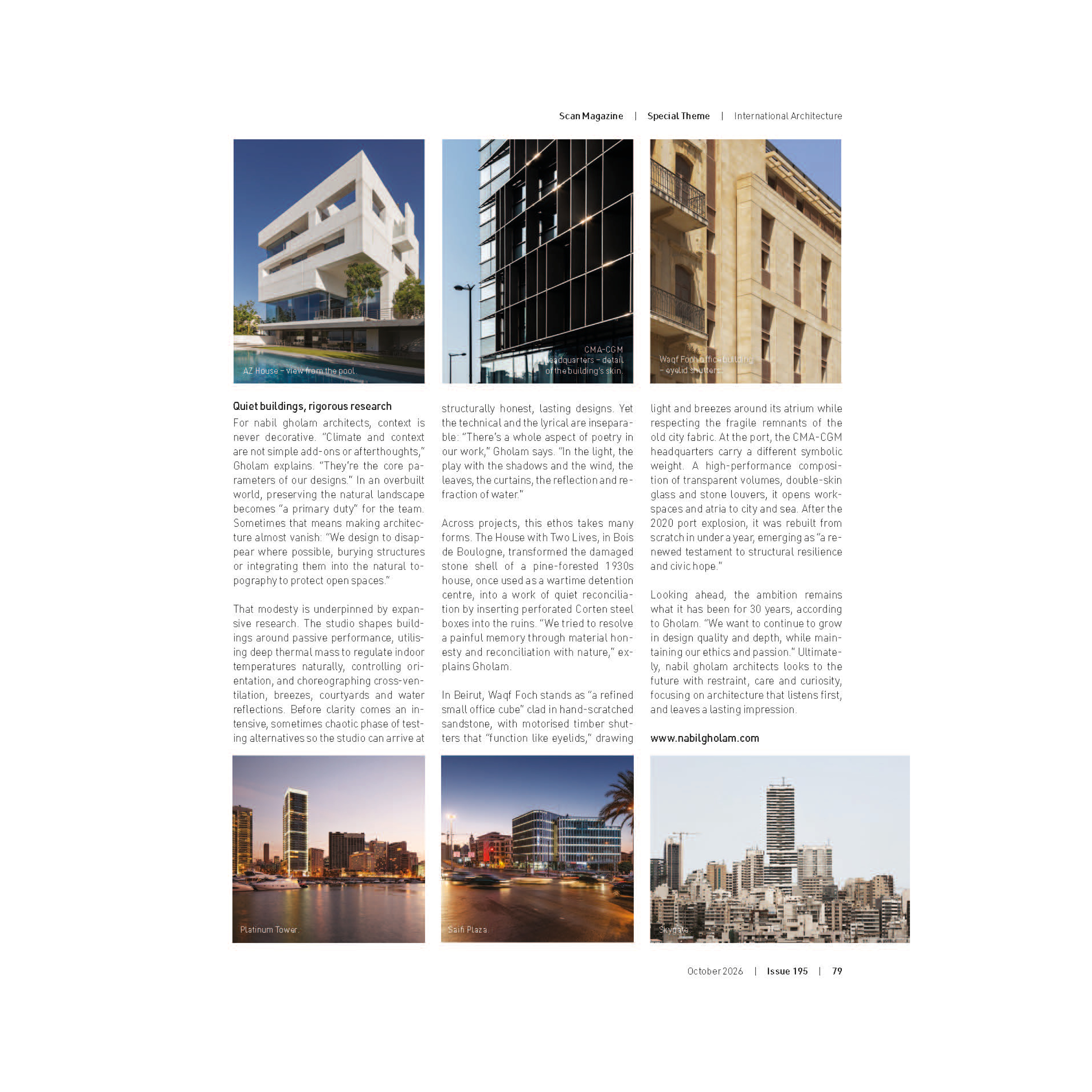
For nabil gholam architects, context is never decorative. “Climate and context are not simple add-ons or afterthoughts,” Gholam explains. “They’re the core parameters of our designs.” In an overbuilt world, preserving the natural landscape becomes “a primary duty” for the team. Sometimes that means making architecture almost vanish: “We design to disappear where possible, burying structures or integrating them into the natural topography to protect open spaces.”
Looking ahead, the ambition remains what it has been for 30 years, according to Gholam. “We want to continue to grow in design quality and depth, while maintaining our ethics and passion.” Ultimately, nabil gholam architects looks to the future with restraint, care and curiosity, focusing on architecture that listens first, and leaves a lasting impression.
For the full article:
nabil gholam architects: Architecture that listens before it speaks